“Who should we call?”: what if safety didn’t begin with police?
This article is the first in a two-part series on the limits of policing and the promise of alternatives.
I grew up in a middle-class, white, well-educated household in a quiet urban neighbourhood. My family, school, and the entire society around me (especially TV shows) taught me that if you’re in trouble, you should turn to the police. They’re your friends. I expect many of you reading this article can resonate with that mentality.
It wasn’t until I was doing human rights work in Central America (with CFSC partner Peace Brigades International) that the first cracks in this myth started to appear to me. During the civil wars of the 1980s, police forces in places such as El Salvador and Guatemala were simply part of the larger security apparatus involved in arresting, torturing and “disappearing” people, displacing communities, and surveilling and even executing activists. I started to take notice of their presence at all times, to be on high alert if they were near. Indeed, when I was arrested and detained, they took me to the Treasury Police torture centre.
I began to think, “Police are not always your friends.” But I still rationalized. This was, after all, in Central America, with a long history of colonial-induced violence and inequality. In Canada the police were still my friends, right? And if there was, at times, police violence, well… that was just a “bad apple.” Ed and Al were police officers and my fastball coaches. And they were kind men. Besides, surely police are necessary. How else would people be kept safe? Who would catch the “bad guys”?
But I come from Manitoba and in 1988 the police shot and killed an unarmed, unthreatening Indigenous leader—JJ Harper—claiming they thought he was a suspect they were seeking in a robbery (even though Harper was a tall, heavy set middle-aged man, while the suspect was a skinny, short teenager. They were both Indigenous, which was, for the Winnipeg police, enough).
This was not, of course, the first police killing of an Indigenous person. And sadly, it has not been the last. But it was egregious, and the police tried to cover it up and the cover up failed. This murder, and the killing of Helen Betty Osborne (and the police inactivity in investigating that death) lead to the Aboriginal Justice Inquiry (AJI) in Manitoba. The AJI was groundbreaking, even though too few of their 296 recommendations have been implemented, even 35 years later. But it did peel back the curtain, showing non-Indigenous people the racist reality that Indigenous (and other BIPOC) people far too often experience at the hands of police and the justice system.
According to a data collection project undertaken by several universities and civil society groups, when it comes to police shootings of civilians, “Taken together, Black and Indigenous people comprise around 8.7 percent of the population in Canada, yet account for 27.2 percent of the police-involved shooting deaths.”1 The AJI had led to even more cracks in my unquestioning belief in policing. Yes, the police may at times make me safer. But I was now aware that the police made other people, especially more marginalized people, much less safe.
One sector of particularly vulnerable people is those with mental health challenges. As the CBC has pointed out, a “substantial majority” of people killed by police struggle with mental health issues, addictions, or both.2 Benjamin Perrin in his book Indictment (if you haven’t read it, I strongly encourage you to do so—it’s excellent and very readable. My Transformative Justice students love it!) includes a chapter on policing. He points out that police operate on a fulcrum of power. When they “power up” (with weaponry, horses and dogs, threats or numbers), most of us “power down.” We submit. But for people in a mental health crisis, or with certain types of neurodivergence, this submission is not a given. Indeed, when the police “power up” they may be triggered into “powering up” too—entering into a dangerous cycle that all too often results in their being killed by police.
As I started to question the inherent goodness of police as a social structure, I also began to learn about the history of policing. It has roots in England where “night watches” were hired to protect the property of the wealthy. The Northwest Mounted Police were sent across the country to subdue Métis and Indigenous independence in the west, and then used to forcibly remove Indigenous children from their families. TV shows like Dragnet were created in collaboration with police with the goal of sanitizing the tarnished image of policing. Not to mention the image that is seared into our collective memory: Derek Chauvin, kneeling on the neck of George Floyd as he pleads “I can’t breathe.”
“A ‘substantial majority’ of people killed by police struggle with mental health issues, addictions, or both.”
So, the police are built on the flawed foundation of existing to protect the property of the wealthy, maintain their positive image through misrepresentations in entertainment media, and pose a threat to large sectors of the population. That’s all obviously problematic. But we need safety, and what other options do we have? Surely it’s just a matter of more oversight, or body cameras, or more training, right?
The problem is, it’s not actually a matter of “a few rotten apples.” The barrel that the apples are stored in is a rotten barrel. It’s a barrel of “us” versus “them”, of power and dominance, of control of people and protection of property. It’s the barrel that damages the apples, not the other way around.
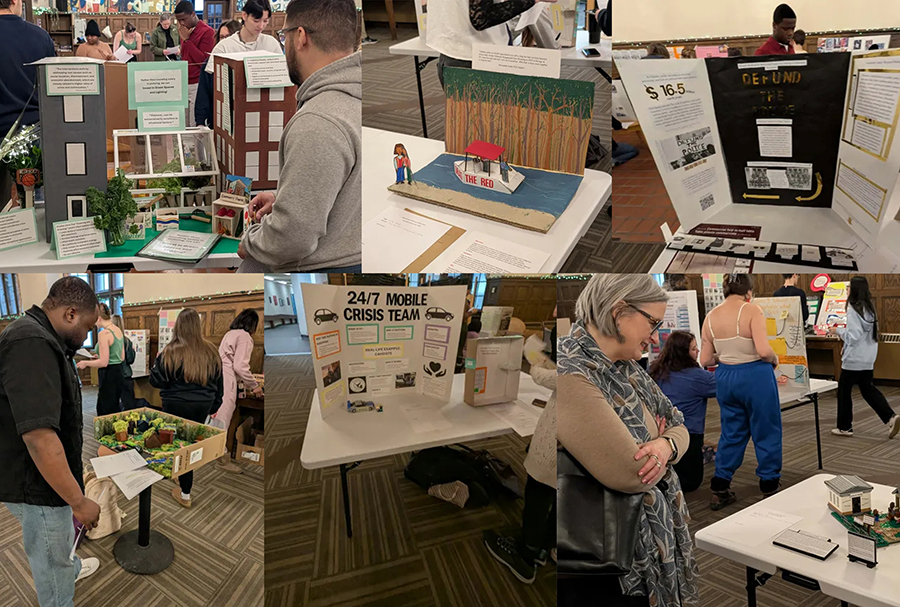
The good news is that there are alternatives. Lots of them. CFSC, with the collaboration of University of Winnipeg student Julien Wyman, is currently compiling a Compendium of alternatives to policing. We have more than 35 entries! Canadian Mennonite University students have already engaged with a draft copy of the Compendium, and we’ll be publishing the final version in the coming months.
Ultimately, we hope to explore the possibility of Canadian Friends formally encouraging alternatives to policing. Watch out for more communication from us on this topic, and stay tuned for our next installment of this series in the Winter 2027 issue of Quaker Concern. We’ll explore a number of the alternatives out there. In the meantime, if you want to check out some options, how about:
- Clan Mothers Healing Village—an Indigenous women-led non-carceral Healing Lodge where vulnerable women and two spirit people can heal, grow, and learn new skills: https://ClanMothers.ca
- Equipe mobile de médiation et d’intervention sociale in Montreal: https://emmismtl.ca and Here2Help in Toronto: https://h2hresponds.ca working to deescalate conflict situations and promote the safety and wellbeing of all community members.
- Downtown Community Safety Partnership—a non-police presence that offers support and care, with a special concern for the unsheltered residents in my area in Winnipeg: https://www.dcsp.ca
Karen Ridd is CFSC’s Transformative Justice Program Coordinator.
- Tracking (In)Justice. “Police-involved deaths are on the rise, as are racial disparities in Canada: A look at recent trends in police-involved deaths in Canada.”, Feb 10, 2023, https://trackinginjustice.ca/analysis-increase-in-deaths-and-racial-disparities ↵
- Kate Nicholson and Jacques Marcoux. “Most Canadians killed in police encounters since 2000 had mental health or substance abuse issues.” CBC, Apr 4, 2018, https://www.cbc.ca/news/investigates/most-canadians-killed-in-police-encounters-since-2000-had-mental-health-or-substance-abuse-issues-1.4602916
Karen Ridd is CFSC’s transformative justice Program Coordinator. ↵