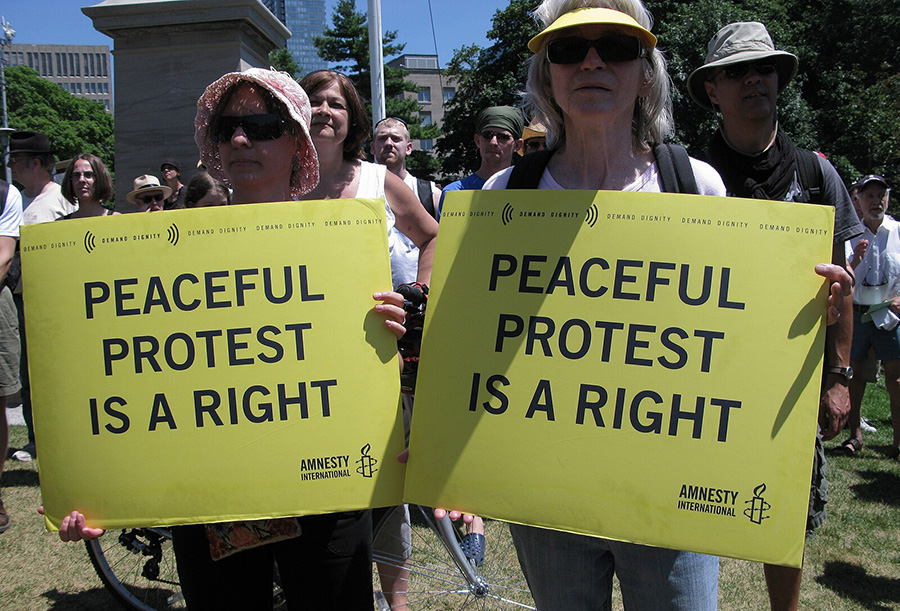
Are we backsliding on civil liberties in Canada?
Canadian Friends are likely familiar with news from the US, UK, and elsewhere in the world about eroding civil liberties and the criminalisation of dissent. We’ve seen stories on deportations, mass surveillance, and trampling the right to protest all becoming more common—and frighteningly—more accepted.
Of concern to Friends in the US, for example, has been the dissolution of the sanctuary laws that provided protections to people (mostly migrants or undocumented people) seeking sanctuary in places of worship. In fact, Friends in Philadelphia Yearly Meeting vs. DHS, launched legal actions against these new powers being enforced by the Department of Homeland Security, arguing that the US Administration’s policy violates the Religious Freedom Restoration Act by allowing immigration law enforcement in or around so-called “protected areas,” including religious services (this was barred by previous US administrations.)1
In the UK, there have also been glaring examples of recent laws impacting civil liberties, especially the right to protest. The Police, Crime, Sentencing and Courts Act 2022 and the Public Order Act 2023 have criminalised protest actions and given powers to police to stop actions that could be deemed disruptive before they occur. An example of this was the police raid on a group of young activists at the Westminster Meeting House in London back in March.
At the time Paul Parker, the recording clerk of Quakers in Britain stated in response to the raid: “No-one has been arrested in a Quaker meeting house in living memory. This aggressive violation of our place of worship and the forceful removal of young people holding a protest group meeting clearly shows what happens when a society criminalises protest. Freedom of speech, assembly, and fair trials are an essential part of free public debate, which underpins democracy.”2
In light of these events, I wondered if something similar could happen in Canada? I posed the question to the International Civil Liberties Monitoring Group (ICLMG), of which CFSC is a founding member. According to them, there are no laws in Canada quite like the UK Public Order Act and others that fully criminalize certain civil disobedience tactics such as “attaching oneself to a building” or blocking any public roads.
ICLMG went on to say that it’s not likely, at this moment, that police in Canada would arrest people at a nonviolent protest planning meeting and Dominique Peschard from the Ligue des droits et libertés of Quebec (who was consulted on the question) agreed.
However, Canada is not immune to these forceful actions. There are many reasons police can restrict or stop a protest and detain or arrest people.3 And there are many ways police and national security agencies try to discourage dissent in the name of national security, preventing/stopping crime, violating bylaws or fighting hate.
For example, in Ottawa, police have intimidated, pushed, heavily ticketed and arrested some organizers and protesters during pro-Palestine marches. This has been allegedly for not following orders to stay on the sidewalk, for violating a bylaw on noise (for simply using megaphones or microphones), or because organizers were protesting the arrests of others in front of the Ottawa police station. Another obvious example is the use of court injunctions and arrests against Wet’suwet’en land defenders. Another pervasive issue is police surveillance and data collection and sharing.4 RCMP or local police have shown up at book launches and protest sign-making gatherings to talk to people with the supposed intent of crime prevention or protecting protesters. And now, cities across Canada are looking to change (or have changed) bylaws to prevent protest in “bubble zones”—making it illegal to protest near places of worship, schools, and community centres.
At present, more forceful police or government actions, like those taking place in the US and UK, are not happening in Canada. But when Canada introduced Bill C-2 recently, it showed us that nothing can be taken for granted. By addressing border security in a way that placates the Trump administration, this omnibus Bill is seeking unrelated powers that they have unsuccessfully attempted to obtain in the past.5
ICLMG advises that a good security culture and having solid plans when engaging in protest activities remain important. It’s also vital to denounce all attempts to undermine civil liberties so that police do not feel emboldened to go further. Vigilance and the exercise of our civil liberties is key to ensuring a healthy and functioning democracy.
Sandra Wiens is CFSC’s Government Relations Representative in Ottawa.
- Immigration Law Reform Institute, “Quakers Seek Sanctuary Right for Illegal Aliens”, February 10, 2025, https://www.irli.org/quakers-seek-sanctuary-right-for-illegal-aliens/ ↵
- Quakers in Britain, “Quakers condemn police raid on Westminster Meeting House”, March 28, 2025, https://www.quaker.org.uk/news-and-events/news/quakers-condemn-police-raid-on-westminster-meeting-house ↵
- Ottawa Police Department, https://www.ottawapolice.ca/en/news-and-updates/demonstrations-and-protests.aspx#Restrictions ↵
- ICLMG, Bill C-59: Mass Surveillance and Cyber Powers, https://iclmg.ca/issues/bill-c-59-the-national-security-act-of-2017/bill-c-59s-mass-surveillance-and-cyber-powers/ ↵
- CFSC, Almost 200 organizations call on Canada to withdraw Bill C-2, June 18, 2025, https://quakerservice.ca/news/almost-200-organizations-call-on-canada-to-withdraw-bill-c-2/ ↵